Reviewed by Nivedita Chauhan
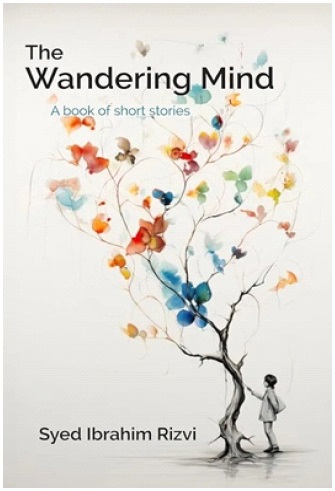
Syed Ibrahim Rizvi’s The Wandering Mind: A Book of Short Stories offers a delightful and engaging reading experience for a variety of reasons. This collection comprises seven short stories — six authored by Prof. Rizvi himself and one, titled “A Night with a Damsel,” posthumously published from the works of his father, the late Agha Rizvi. Each story is meticulously crafted, exploring diverse themes and dimensions. Rizvi, a distinguished professor of Biochemistry at the University of Allahabad, intriguingly incorporates his scientific knowledge into his storytelling, enriching his narratives with subtle references to chemicals and compounds.
The collection adeptly captures the spectrum of human emotions that render existence a meaningful journey. Themes such as college life and teenage romance, tragedy, the underworld’s entanglements with politics, courtroom drama, human values, and platonic love are thoughtfully explored, offering readers a profound engagement with the complexities of human experience.
The title, The Wandering Mind, aptly reflects the essence of the stories. The phrase signifies a mental state where attention drifts from the immediate task or situation to unrelated thoughts, memories, or imaginations. The thematic resonance is skilfully woven into the narratives, where the protagonists’ psyches and experiences mirror the wandering nature of the human mind. For instance, in one story, a judge’s flashbacks enable him to deliver a nuanced judgement, ensuring justice for both the accused and the plaintiff. In another, the antagonist experiences politic justice, a consequence of his own actions. The stories traverse a spectrum of trust, devotion, and betrayal— whether circumstantial or intentional— interwoven seamlessly into the narrative fabric. Rizvi’s storytelling is a testament to his ability to navigate complex human emotions and relationships, making The Wandering Mind a compelling read for both casual readers and literary enthusiasts.
The themes of platonic love and unwavering devotion are central to “Someone Else’s Bride”, where the narrator skilfully employs symbolism to foreshadow pivotal events. The trijunction where Rashid first glimpses Zeba subtly hints at the triangular love story that unfolds. Though Zeba and Rashid share a profound love for each other, destiny intervenes, and Zeba becomes wife of Zamal, Rashid’s senior by two years. When Rashid re-unites with Zeba after five years, he is unable to suppress his deep and enduring love for her, despite the reality that she is bound to another man. Zamal, unable to father a child, succumbs to despair and takes his own life, hoping that Zeba will move on with Rashid and build a family. However, Zeba, bound by her steadfast love and loyalty to Zamal, chooses to end her own life rather than be with another man.
Prof. Rizvi’s poignant narrative critiques the erosion of unconditional love and devotion in contemporary relationships offering a profound reflection on the enduring, yet, tragic, nature of love and fidelity. Prof. Rizvi takes a stance on the issues of social inequality and justice in his “A Judicial Dilemma.” Judge Sushil Kumar is renowned for his unprecedented pronouncements and is revered by all. He is punctual and honest, and while delivering his judgements, he considers both sides and delivers justice impartially. As the story proceeds, he has got to attend a murder case. Although the incident was unintentional, the convict murdered Father Joseph, the Principal of St. Andrews School. Manoj, a rickshaw puller by profession, could not afford to pay his son’s fee and had gone to meet the Principal to discuss the matter. A bright and intelligent student like Manoj had to leave his education because of a similar situation some thirty years ago when his own father was murdered.
As the proceedings continue, Judge Sushil Kumar’s mind wanders through the streets of memory lane. Upon discovering that Manoj is his former classmate who had to leave the school due to his father’s murder, the judge investigates the matter further. He learns that it is his own father who had murdered Manoj’s father. Despite feeling uneasy, this revelation does not hinder his ability to deliver a fair judgement. Judge Sushil Kumar sentences Manoj to life imprisonment but also orders that Anuj’s (Manoj’s son) education be sponsored by school administration. Furthermore, for his higher education Government would sponsor it. However, the secret is kept confidential that Judge Sushil Kumar is the one sponsoring Anuj’s education.
The human psyche’s quest for justice finds a compelling portrayal in “The Last Laugh.” Through a poignant narrative, destiny intervenes to deliver justice in a world rife with exploitation and corruption. The protagonist, Pappu, is a victim of egregious injustice: his family is brutally murdered by Bhai, his son and others, who sought to usurp their land. Orphaned, Pappu is sold to a begging cartel, where his legs are amputated, forcing him into a life of despair. Meanwhile, Prabhas, with his political clout and underworld connections, thrives a web of infamy, seemingly invincible in his nefarious pursuits.
However, fate ensures that Prabhas faces the consequences of his actions. Pappu’s father, a snake charmer, had once made a living by selling venom, a skill Pappu inherits. This legacy becomes the instrument of justice as Pappu uses it to avenge his family’s death. The story is both motivational and reflective, exploring the moral complexities of justice. While justice ideally belongs to the judiciary, when institutions fail and power corrupts, individuals often take matters into their own hands. This narrative underscores the timeless truth of karma: what one sows, one eventually reaps. This story is a narration of power struggle between two domains of the society. The rich people hold the power and also the system. The society and its functionality are run by them, on the other hand the poor and the powerless had to bow down and endure all the sufferings.
Love is the most intimate and beautiful feeling in this world. It is easier to fall in love than to stay in it. Through the story of Zuned (“A Bangle Seller”), Prof. Rizvi presents two contrasting sides of love. An elderly man, who without any second thought, buys bangles for his blind wife, she could not see things around her but she can feel them when she touches them, yet he remains deeply in love with her. Catharsis strikes as Zuned reminiscences about his moments with Zeba. Zeba, who struggles between her husband and her child, finds herself neglected. Zuned’s attitude towards her has changed; he loves her because of her beauty, which has now faded with child bearing.
“The Neighbour’s Wife” is a tale of human frailty and the consequences of avarice. Manoj and Varsha, along with their son, live a contended life until they relocate to a new city. Manoj, an Assistant Manager at a renowned bank, becomes entangled with Jyoti, a colleague and neighbour. Meanwhile, Varsha finds solace in the company of Jyoti’s husband, Atul. Through this narrative, Prof. Rizvi juxtaposes the ideas of platonic love and fidelity in one story against the infidelity and moral decline depicted in another. This thematic contrast underscores the complexity of human relationships, offering profound insights into the sanctity and fragility of marital bonds.
Humans remain some of the most complicated creatures on this earth to interpret. Sunaina (“The Second Love”) has recently finished her PhD and her parents insist her to get married. They present her with two marriage proposals: Rakesh Raj, a businessman, and Sudhir Majumdar, a chartered accountant by profession. Although reluctant to consider marriage, Sunaina decides to entertain the idea and initiates a conversation with Rakesh.
Despite going on several dates with Rakesh, Sunaina feels an emotional disconnect. Although Rakesh expresses love for Sunain, his pragmatic approach leaves her yearning for something deeper. However, when discussing with her parents, Sunaina inadvertently paints a favourable picture, leading them to misunderstand her feelings and proceeds with wedding arrangements.
Curiosity often leads to unwanted roads, Sunaina’s curiosity about Sudhir makes her to initiate a dialogue with him. Over the course of few meetings, she discovers a kindred spirit in him, realising Sudhir has all the qualities she was looking in a life partner. Despite developing connection with Sudhir, Sunaina follows her parents’ wish and gets married with Rakesh.
Life was beaming with happiness for Sunaina and her family. However, Rakesh is at home on the occasion of their son Amol’s birthday. Following the day Rakesh is found dead under unexpected circumstances. The tragedy disrupts their lives, forcing Sunaina to take on all the business matters in her hands. As she navigates the business complexities, she seeks assistance from a business firm, only to encounter Sudhir once again. Their reunion and rekindled affection is resisted by Amol, who views it as a betrayal of his father’s memory. Unbeknownst to him, Sudhir is his biological father, in a fit of rage Amol tragically ends Sudhir’s life, leaving Sunaina grappling with the profound consequences of the choices made years earlier and the truths leave untold.
In “A Night with a Damsel,” a posthumous publication of Prof. Rizvi’s father, Late Agha Rizvi, the narrative transports readers to an era of radios, cricket enthusiasm and simpler joys. The story incorporates Freudian psychoanalytic theory, particularly the concept of the subconscious and dream interpretation. This story is written in first person; hence, the protagonist is assumed as late Mr. Rizvi. The protagonist, during one of his tours, purchases a lottery ticket, only to discover it is part of a scam. As a result, he spends a night in a hotel with a fellow victim, a beautiful lady.
In his slumber, the protagonist experiences a surreal dream where he plays a Ranji Trophy match, wins a lottery, and revels a romantic escapade. Upon awakening, he reconciles with reality: his status as unmarried, his inability to play cricket due to physical injury, and the cancellation of the match. This story brims with nostalgia, vividly depicting an era of legendry cricketers, train journeys, radio broadcasts, and joy derived from minimal resources.
Prof. Rizvi’s compilation of short stories is written in simpler style to facilitate a novice reader as well. This compilation deftly captures the intricacies of human emotions, societal challenges and the enduring spirit of nostalgia. Each story stands as a testament to his profound understanding of human nature. He weaves characters from the daily lives and makes stories relatable, and this makes The Wandering Mind a worthy read.