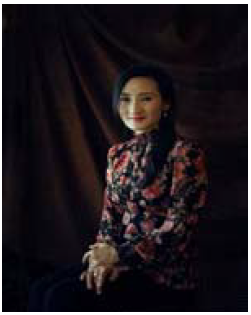
Avinuo Kire is one of the emerging writers from Nagaland, India. She has authored two short story collections, The Power to Forgive and Other Stories (Zubaan 2015), The Last Light of Glory Days: Stories from Nagaland (Speaking Tiger 2021), and a collection of poems Where Wildflowers Grow (Barkweaver 2015). She has also co-authored an anthology of oral narratives, Naga Heritage Centre: People Stories (Pen Thrill 2016). Her last book is a folk fantasy novel Where the Cobbled Path Leads (Penguin Random House 2023). She currently shuttles her time between Nagaland and Thimphu, Bhutan, while working on her next book.
Raam Kumar T.: Who are the sources of inspiration behind your fictional characters?
Avinuo Kire. Inspiration can be found within and just about anywhere. It can often be abstract but most times, I am inspired by people, particularly ordinary people quietly living extraordinary lives. I like listening to people of all ages from all walks of life but the elderly holds my utmost respect with their huge repository of life experiences, knowledge of folktales, myths and traditional wisdom. I’m always on the lookout for oral narrators with my trusty recorder at hand. It’s immensely sad to know that my generation is the last to be linked with the dying generation of oral storytellers.
RKT: What is your view on the term “Seven Sisters”?
AK: I can understand how this term is convenient in the geographical sense. That being said, while referring to the North East states as the ‘seven sister states’, it is pertinent to be mindful that each state has its own unique history, culture and tradition. So the entire region cannot be defined as an ethnographic whole or within a singular historic framework.
RKT: Your stories are inbuilt with historical records, trauma, realism and mythical elements. How do you find one voice to unite diverse elements?
AK: These are all elements of my heritage- trauma that comes with a prolonged conflict situation, myths and folklore from our vibrant oral tradition, etc. I don’t necessarily make a conscious effort to unite diverse elements into one voice but I think it comes quite naturally considering that I am writing about the human experience and this experience is diverse and multidimensional.
RKT: “New tales from an old world” stories are infused with supernatural elements. How far these factors are incorporated in contemporary Naga society?
AK: A deep consciousness of spirit activity forms the basis of traditional Naga spirituality. In recent years however, the shift towards globalization has had its effects on the Nagas as the gradual change in lifestyles has altered our way of life and thought patterns in the globalized melting pot. Traditional belief system and practices involving the supernatural still exists in contemporary Naga society but it is also fast vanishing. This collection is therefore a modest attempt to preserve a glimpse of the old world.
RKT: I find myths, legends and rituals as the representations of an indigenous identity. Do literary narrations preserve and transfer these for future generation without losing their quintessence?
AK: I agree. Traditionally, Nagas are a highly oral indigenous society but where we are now, urgent documentation of our oral narratives is the first step towards preserving our oral narratives which constitute intangible heritage. This applies to literary narrations including fiction writing, especially when it is told against the backdrop of the traditional Naga way of life incorporating myths, legends and rituals. I don’t think literary narrations/writing compromises orality or results in ‘losing its quintessence’. In a fast changing world, it is important to find a way forward where the oral and written can complement each other and also necessitate each other.
RKT: I feel that the ethnic heritage of North East communities is less shared with other regions of mainstream India. Can you comment on this?
AK: Definitely. In this regard, our formal education from the primary school level onwards needs to be more inclusive of the unique history and culture of different groups of people, not just North East communities but Adivasi tribal literature and others. I daresay this will also greatly ease issues of intolerance, racism and identity which we often face today. I must also add that research undertakings such as yours are very important.
Needless to say, India is a country of multiple narratives and because of the endless variety of geographical features, cultural patterns, linguistic and racial diversity that this country presents, a singular mainstream narrative does great injustice, especially to its minority groups whose stories remain unheard. There is often the danger of a single grand narrative eclipsing the histories and stories of minorities.
RKT: In your stories ‘Fallen Bird’, ‘Promise of Camellias’ and ‘The Power to Forgive’, the female characters experience the loss of identity within their clan. Is this because of the gender bias followed in tribal community?
AK: It would not be fair to entirely blame gender bias for loss of identity in the female characters. That being said, definitely, the shortcomings in the institution of Patriarchy where women are often seen but not heard, the suppression of the female voice, essentially, is an important trigger which cannot be ignored.
RKT: The traumatic events of Indo-Naga conflict are depicted in your writings. Do those insurgent activities have impact over present generation? If yes, how far the present generation is aware of those troubled times?
Without a doubt, the decades long Indo-Naga conflict impacts the present generation, directly as well as indirectly. As you may be aware, the Indian military committed terrible atrocities during the most turbulent period of the undeclared Indo Naga war which spans the 1950s till the 1960s. This war devastated the lives of countless Naga families. Today, the older generation who survived this turbulent era continues to live with painful and traumatic memories. With tyrannical laws like AFSPA in place, not a single army, military personnel or soldier has been prosecuted 116 Akshara, Vol. 17, May 2025 for war crimes. Healing is difficult when one is deprived justice. Many have found comfort in faith but they are still human. These searing memories are passed on to the younger generations and this leads to generational trauma, often with the younger generation caught at crossroads.
Nagaland is largely peaceful today. But as the Indo Naga conflict remains unresolved to this very day, the common man is now faced with new challenges amidst factional groups who are also trying to survive. Issues like multiple taxation, extortion, etc., are rampant and they affect all aspects of life from the economy to employment opportunities.
RKT: Do the insurgent activities destroy the opportunities for the development of the region as narrated by the nation state?
AK: In addition to the previous response. Also, may I add that insurgency is a point of view? For many Nagas, they are regarded as National workers and not insurgents.
RKT: Do the present ethnographic studies on North East bring the real ancestral heritage to mainstream society?
AK: I hope so, although to what extent, I can’t say.
RKT: What shall be the real essence of North East Literature from your perspective?
AK: This is a difficult question for varied reasons. As expressed earlier (question noumber 2.), the North East states cannot be defined within a singular historic framework. There are many ethnicities and cultural groups, each with its own unique literature, in both oral and written forms. At the same time, certain shared experiences have brought forth dominant themes which have effectively tied our collective narratives and shaped it into the genre of Literature from the North East. North East literature is not a literature of violence and insurgency, as often erroneously perceived by the mainstream society.
Ultimately, literature, regardless of genre, time or place, is about life, about what it is to be human, and so transcends all boundaries, real or imagined. Our literature reflects and records our experiences from our perspectives.
RKT: Could you share your incentive idea of becoming a writer? Either it is inborn within or you believe it as mode of expression of your community?
AK: Inborn, certainly. Community and all else flows through this.
RKT: Being a significant woman writer from the North East region of India what shall be the ‘promise to your motherland’?
AK: I don’t have any such grand ambition. I regard myself simply as a storyteller, telling stories inspired by the people and world I live in.
RKT: I could not find your exact ancestral history. Could you please provide a brief note of it?
AK: I am an Angami Naga. Both my parents belong to the Angami tribe hailing from Kohima village in Nagaland.
RKT: Thank you.