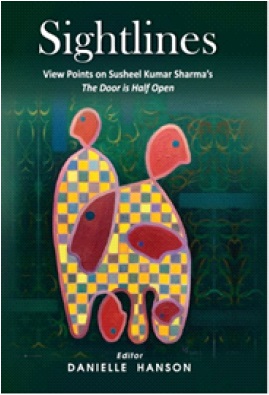
Reviewed by Shibanur Rahman
This book brings a bouquet of multifaceted exploration of Prof. Sharma’s enigmatic collection of poems, exploring the themes and narrat ive intr icacies from var ious perspectives. As readers get on this literary journey, they are invited to traverse the convoluted yet effortless corridors of Prof. Sharma’s imagination and unravel the mysteries concealed within the pages of The Door is Half Open. Through a kaleidoscope of perspectives ranging from literary critique to philosophical study, this book review seeks to illumine the innumerable layers of meaning entrenched within Prof. Sharma’s magnum opus. From the lens of literary scholars to the musings of everyday readers, each perspective contributes to a richer understanding of the poetry’s significance and resonance. Within these pages, readers like me will always come across divergent analyses and fervent debates as critics grapple with the intricacy of Prof. Sharma’s narrative. On the one hand, some may find themselves drawn to the verse’s fantastical elements and allegorical hints, while on the other hand, some would appreciate its thematic coherence and narrative structure. Regardless of the vantage point, this book is a testament to the poet’s ability to inspire discourse and provoke contemplation and meditation.
Susheel Kumar Sharma’s The Door is Half Open provides a tribute to the verses’ potential to motivate dialogues and aggravate deliberation and consideration. He has established himself through his collection as a poet to be remembered and a person to be acknowledged. The book Sightlines highlights various aspects of Sharma’s poetry. To understand the range and scale of the book, it is essential to segregate it in a cohesive sequence. Firstly, I would like to discuss about some of the articles in the book about poetry on nature and the environment. In his article “Poetic Flavour of Susheel Kumar Sharma” Arbind Kumar Choudhary rightly says that “Susheel Kumar Sharma is not only the suitor of the cultural heraldry of India but also the painter of the dazzling picture of natural iridescence for the fragrance of the conscience.” (3) His passion for poetry, growing around him, is free from materialistic fervor and more inclined towards spiritual sensation. His painting of nature’s escape through his words and society’s struggle gives him a unique poetic positioning. Even Kalikinkar Pattanayak sees Prof. Sharma as a sensitive soul towards the environment. Pattanayak’s article “The Poetry of the Green: Revisiting Marvell’s ‘Thoughts in a Garden’ & Sharma’s ‘Mangoes’” can attract eyeballs because Andrew Marvell’s “Thoughts in a Garden” and Susheel Kumar Sharma’s “Mangoes” are brought within the same canvas. On one hand, Marvell’s “Thoughts in a Garden” is a unique poem in its romantic expression and purely metaphysical in its word game, on the other hand, Sharma’s “Mangoes” is an optimum example of his love for nature and the environment. Whether it is Sharma or Marvell, both are driven by the same motive: love for nature, compassion toward the human condition, and concern for civilization. According to Pattanayak, Marvell’s poetry is more romanticized, but with Sharma, poetry is more into the realistic side of nature. Pattanayak rightly points out that “While Marvell meanders among society, garden and paradise, Sharma strays towards a cow and a cowherd.” (30) Kalikinkar Pattanayak, in his second article in this book entitled “Reflecting on The Door is Half Open and For Reasons Unknown: The Ecological Perspectives,” voices an idea that poetry should be used as a tool or a platform where the problems of a war-torn world should be discussed and a particular focus must be conferred upon the ecological degradation. Another article in the same segment of poetry for nature and environment, “Environment and Culture in the Anthropocene: Exploring ‘Ganga Mata - A Prayer’ & ‘Tintern Abbey’” by Mary Mohanty is, on one hand, an exciting comparison between Ganga and Wye, on the other hand, the article shares its concern by comparing the vision of one poet at the beginning of the environmental crisis with the poet of our time when the situation has reached its zenith. This article also tries to stitch many centuries by bringing together the profound love for William Wordsworth’s nature and the deep ecological concerns of Susheel Kumar Sharma. The article entitled “Ecological Consciousness in The Door is Half Open” by Om Dwivedi & Navya Aravind Karalingannavar talks about Prof. Sharma’s collection of poems, The Door is Half Open, where there is a presence of cosmopolitanism. This collection is also a personification of ecological realization. The article presents the idea of Prof. Sharma to melt the boundaries, not only between “humans and his fellow beings, but also between the humans and more-than humans.” (147)
The second segment that this book illuminates is Prof. Sharma’s concentration on the mythical structure rapped by the regional cultural overtone. It has poetry on religion, myth, and culture. In his article “Spiritual, Socio-Cultural and Political Consciousness in The Door is Half Open”, Rabindra Kumar Verma talks about writing styles of the Indian poetry, which can be further divided into three classifications – “imitative, assimilative, and experimental.” (167) Whether it was Henry Louis Vivian Derozio or the great Jayanta Mahapatra, the Indian English verses have always involved themes of human concerns like society, politics, cultures, traditions, religion, and so on. But Prof. Sharma, the bard of the present and future of Indian English poetry, crosses the restraint of these three categories. For him, these categories limit the poetry’s capacities, and Indian culture is too wide to fit into any specific fences. He tries to inspire the continuing impact of spirituality and socio-culture among readers through his anthology of verses. His unique style of writing, like the blending of biblical and ancient Indian myths and archetypes are very exclusive pattern in Indian English poetry. Rashmi Jain in her article entitled “The Door is Half Open: A Mythical Study,” points out significant existing concerns like women empowerment, spiritual deterioration, environmental dilapidation, and so on as portrayed in Sharma’s poems – “Ganga Mata – A Prayer,” “Routine,” “Agony,” “Dilemma” and some others. Syed Ahmad Raza Abidi has seen Prof. Sharma’s poetic verses differently. In his article “Spiritual Strain in Susheel Kumar Sharma’s The Door is Half Open,” he rightly finds Prof. Sharma as a master of Indian culture and ethos. Over here, Ahmad Raza sees Prof. Sharma more as an instructor through his powerful poetry than just an appreciator through his humanistic vision, which is deeply rooted in Indian soil. Prof. Sharma’s verses mirror the moods of a very human poet and an intricate era to which he belongs. The other article in the same book by Wendy J. Truran presents an optimistic side of Prof. Sharma. In this article, entitled “The Ambivalence of Belief: Hope & Despair in Susheel Kumar Sharma’s The Door is Half Open,” Truran shows Prof. Sharma a firm believer, perhaps his source of optimism comes from his sturdy belief in his religion and spirituality. Through this article, Truran presents Prof. Sharma and how he challenges regressive belief systems, envy, and the efforts of everyday life. His collection The Door is Half Open not only portrays human suffering but also emphasizes how peace, harmony, and, most importantly hope works as an antigen against the human suffering. With thought-provoking analyses and divers e array of perspectives, this book promises to engage readers in dialogues that transcend the boundaries of literature, offering fresh insights into Sharma’s influential work.