Reviewed by Monika Malhotra
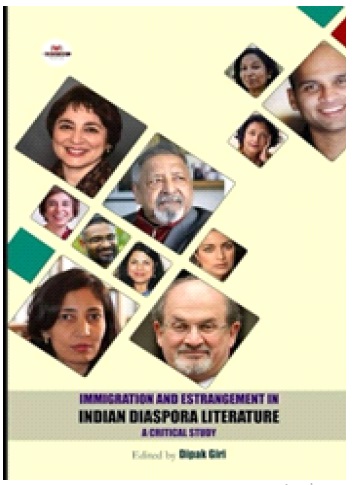
Dipak Giri’s Immigration and Estrangement in Indian Diaspora Literature: A Critical Study is a compelling anthology that delves into the experiences of displacement, estrangement, and identity negotiation within the Indian Diaspora. Addressing the lived experiences of diasporic communities through a variety of cultural, literary and sociological lenses, the book under review is both current and pertinent.
It is a collection of fourteen chapters each exploring distinct facets of the diasporic experience and effectively offering a wide-ranging critical examination of how immigration shapes individual and collective identities. Starting with the introduction to the term ‘Diaspora’, the book encompasses wider issues like migration, identity crisis, cultural conflicts and hybridity, nostalgia for the homeland, challenges of assimilation, adaptation and amalgamation. Through an analytical lens, the book examines writings of prominent Indian diasporic authors such as V. S. Naipaul, Jhumpa Lahiri, Kiran Desai, Bharati Mukherjee, Chitra Banerjee Divakaruni and Salman Rushdie. The author in the introduction employs the ideas of critical thinkers like Edward Said, Gayatri Chakravorty Spivak and Homi K. Bhabha to frame his discussion lending academic rigour to the analyses. The book effectively conveys the sense of alienation that immigrants face as they strive to adjust themselves to new cultural situations and deals with the loss of their native country. It also captures the ongoing struggles of holding on to cultural heritage while integrating into new social and cultural contexts.
The first article “Assertive Nature of Indian Women Immigrants as an Indispensable Outcome of Gender and Culture Oriented Restraints: A Study of Manju Kapur’s Immigrant and Chitra Banerjee Divakaruni’s The Vine of Desire” emphasises gender individuality. The chapter ponders upon the take that women should have equal rights to decide their course of life having a feeling of belonging to the places of strange environments by keeping their tradition and culture intact. The act of assertion to live as a single woman in the same house with her husband proves that women should not remain as silent spectators to the unjust happenings in their lives. The article “A Study of Multiculturalism in Kiran Desai’s The Inheritance of Loss” analyses the novel from cultural perspectives and how multiculturalism impacts the life of an immigrant encompassing aspects of diaspora, hybridity, assimilation, inbetweenness and other cultural-oriented topics. The paper “Diasporic Concerns of Identity in The Namesake” focuses on second–generation immigrants and a new paradigm of bicultural experiences. The article explains the feeling of anxiety and unease as a result of losing one’s identity in a foreign land, “It can be understood that main reason that Gogol gets irritated by the name is that it is neither American nor Indian which represents his mental state where he questions himself about being a US citizen with Bengali Origin” (80). Lahiri “beautifully conveys the émigré’s disorientation, nostalgia, and yearning for tastes, smells, and customs left behind” (The Los Angeles Times Book Review). The article in the same perspective analyses how ethnicity, genders and the socio-cultural forces have impacted the immigrants bringing in them uneasiness, anxieties, nostalgia, restlessness, alienation, identity crisis, disconnection in relationship and the ultimate assimilation which are the important components of postcolonial diaspora. Another article on “Shifting Identities and Cross-cultural Conflicts in Jhumpa Lahiri’s Interpreter of Interpreter of Maladies and Unaccustomed Earth” investigates the nature of the cross-cultural conflicts and confrontations. The paper “Homeland or Hostland, A Limbotic Existence amidst of Diasporic Space: Special References to the Selected Works of Meena Alexander” discusses the concept of Home and Space and argues how diaspora is an extension of the place left behind the home. It also provides the way to grasp issues associated with depression, the idea of homeland and the farreaching impact of long-lost homeland while staying on the hostland. The last chapter “Home and Away: Migrancy, Diasporicity and Identity in Select Novels of V. S. Naipaul” by Dipak Giri analyses The Mimic Men, A House for Mr. Biswas, A Bend in the River and Half a Life as the personal quest for meaning in a world that is perverse and alien. The paper aptly hints on the central theme of the book, i.e. the literary world of Naipaul obsessed with the problem of migrancy, diasporicity and identity.