
Post-independence India has produced many brilliant writers whose works have their own importance in the field of Indian English literature. These writers have brought new themes and new styles of writing that have enriched Indian English literature to a great extent. Besides fiction authors, poets have emerged on a large scale, and poetry is receiving its due attention for studies, research and discussion. This situation is best exemplified in an increasing number of publications of poetry collections and anthologies, along with print and online journals and magazines.
William Henry Hudson said that “[e]very writer is a ‘product’ of his time”. Time helps the writer to develop a particular taste or perception and express it in their own words, resulting in literature. It leads them in the direction of creating their own world. This world can be spiritual: a cherished shelter for them, and sometimes an escape from real-life situations and material pleasure. There is a possibility that they might seek to strengthen the social and cultural values that gave them an identity.
They might also develop a zeal for bringing change and revolution into the present social and political system for the sake of developing a scientific temperament, ecological awareness, fraternity, equality, justice or global peace and harmony.
Modern Indian poetry in English is rich with all these elements. Research on these subjects can prove a precious contribution to the academic as well as literary world, for the further exploration and enrichment of Indian English literature.
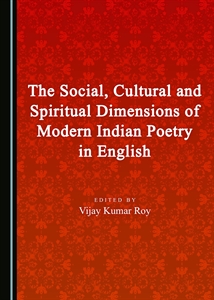
The book The Social, Cultural and Spiritual Dimensions of Modern Indian Poetry in English (2017) examines the work of modern Indian poets, particularly those whose verse is less explored.
Aju Mukhopadhyay in his paper, “Devotional Zeal in Modern Poetry”, discusses the themes of spirituality and mystical experiences in the poetry of Dev Ganguly, Syed Ameeruddin, Rudra Narayan Mishra, N. Karthikeyan Osho, O. P. Arora and Anuradha Bhattacharya.
Professor Nigamananda Das, in his detailed study of the poetry of Northeastern India, explores eco-cultural and spiritual aspects in the poetry of Mamang Dai, Yumlam Tana, Hem Barua, Maheswar Neog, Lakshahira Das, Dayananda Pathak, Umakanta Sarma, Bhupati Das, Rupanjali Baruah, Robin S. Ngangom, R. K. Madhubir, Easterine Kire, Temsula Ao, Rajendra Bhandari, Bhaskar Roy Barman, and also the English rendering of the poetry of Hiren Bhattacharya, Bhupen Hazarika, Nagen Saikia, Megan Kachari and Kathita Hatibaruah.
The poetry of K. V. Raghupati has been taken by two authors. V. Sunitha in her paper, “Precepts to People from the Peepal Tree: An Appraisal of K. V. Raghupathi’s Wisdom of the Peepal Tree”, depicts the ideology that nature “uplifts human lives with its unarticulated but explicit philosophies” in a number of ways in order to spread good values from generation to generation. G. Srilatha’s paper, “Reflections on K. V. Raghupati’s Voice of the Valley”, depicts the philosophy of human life and the relationship between human beings and the Almighty through mystical experiences.
Vijay Kumar Roy’s paper, “The Fusion of Social and Spiritual Elements in the Poetry of R. K. Singh”, illustrates poetry as social criticism, and the need for liberation from superstitions, ignorance, rituals and evils in order to change materialistic views into spiritual experiences.
The poetry of Pashupati Jha has been discussed by two scholars. In the first paper, “Spiritual and Sociocultural Concerns in the Poetry of Pashupati Jha”, Kusum Kundu discusses religious, social, cultural and political aspects of Jha’s poetry and shows that Professor Jha “simply depicts the scene and does not dictate his terms”. He does not impose his own ideas on the readers. Thus, he has all the qualities of a true poet. The second paper, “Pashupati Jha’s Poetry: A Journey to ‘Nirvana’ Amidst ‘Unrest’, ‘Realization’, ‘Truth’, ‘Acceptance’ and ‘Submission’”, by Ram Kulesh Thakur presents Jha’s work as “a departure from the traditional notions of poetry” and as introducing new ideals, evolving new styles and attaining liberation “through the medium of his poetry”.
V. Sunitha, in her paper, “Shujaat Hussain’s Civic Concern: A Critical Appraisal of His Selected Poems”, discusses “the ubiquitous spiritual, cultural and political aspects” of Hussain’s poetry. She also highlights the “sense of duty, responsibility, humility, ethics and moral values” reflected in his work.
There are two papers on the poetry of K. V. Dominic. The first, by D. C. Chambial, is a thorough analysis of Dominic’s poetry as social criticism. Spiritual and aesthetic grounds also find proper mention in it. Another paper, “The Matrix of Cultural Coexistence in the Floral, Faunal and Human Worlds as Presented in K. V. Dominic’s Winged Reason” by Kavitha Gopalakrishnan, deals with “coexistence and cohesion” between human beings and flora and fauna – and, at the same time, an exposition of the latent pain of speechless animals and plants caused by human beings.
Robert Maddox-Harle, in his paper, “The Poetry of Sunil Sharma: An Expression of Love and Liberal Humanism”, discusses true “liberal humanism” in the light of love and equality, and compares the poetry of Sunil Sharma with some of the notable stalwarts. He also highlights “divine elements” in Sharma’s poetry that provide a “transcendental experience”.
There are two papers on the poetry of Vijay Kumar Roy. In the first paper, “Reconnecting with the Sublime: The Poetry of Vijay Kumar Roy”, Robert Maddox-Harle examines the connection in Roy’s poetry of nature with spirituality, with “shades of mystical experience”, “animistic themes”, “a deep respect for the natural world” and social criticism – all to rise “above our base material existence”. He compares the poetry of Roy with that of John Donne, William Wordsworth and John Keats. In the second paper, “Spiritual Trends in the Poetry of Vijay Kumar Roy”, Bhaskar Roy Barman begins with a historical background of Indian poetry in English and analyses the poetry of Roy in the light of divinizing nature, love, beauty, surrendering to the Almighty and the complexities of life.
In the last paper, “Sociopolitical Issues in the Poetry of Meena Kandasamy”, C. L. Shilaja discusses the issues of the dalit (oppressed) class in the poetry of Meena Kandasamy, who is best known for her “inflammatory writing”.
Thus, this book covers the social, cultural and spiritual dimensions of modern Indian poetry along with some other relevant themes that can prove useful to students, teachers and all those interested in Indian English poetry for study and research purposes.
I am thankful to all the esteemed contributors who helped bring about the book. I am grateful to Ms. Victoria Carruthers and the whole team at Cambridge Scholars Publishing, Newcastle upon Tyne, United Kingdom for encouraging me and publishing the book in such an attractive format.
Vijay Kumar Roy